Annulment of Marriage in Singapore: Grounds and Effects
Learn the grounds, filing steps and legal effects of annulment of marriage in Singapore, and how it differs from divorce. General information only.
If a marriage ends soon after the wedding, does that mean it can be annulled rather than dissolved by divorce? Not necessarily. For an annulment of marriage in Singapore, the central question isn't how long the marriage lasted or how unhappy the spouses became. It's whether the facts establish a recognised legal ground for nullity.
What Annulment Means and How It Differs From Divorce
An annulment is a court judgment of nullity under the Women's Charter. It either declares a marriage void or sets aside a voidable marriage on a statutory ground. Either spouse can seek that judgment, but agreement between the spouses isn't enough by itself.
A useful analogy is the difference between ending an agreement and challenging its legal foundation. Divorce ends a valid marriage; annulment asks whether the marriage was legally invalid or whether a specified defect allows the court to set it aside.
That distinction prevents a common misunderstanding: annulment isn't a faster divorce. A short, unhappy or childless marriage doesn't automatically qualify, and choosing a different label won't remove the need to prove the legal basis for the application.
Annulment versus divorce at a glance
| Aspect | Annulment (judgment of nullity) | Divorce |
|---|---|---|
| Legal meaning | Court declares a void marriage invalid, or sets aside a voidable marriage | Court ends a valid marriage |
| Legal basis | A statutory nullity ground under the Women's Charter | Irretrievable breakdown, proven by one of the statutory facts |
| Status afterwards | Void: treated as never validly married. Voidable: effective until final judgment | Divorced from the date the divorce becomes final |
| Eligibility | Only on a recognised ground; unhappiness alone isn't enough | Breakdown must be proven, and filing within 3 years of marriage generally needs court leave |
| Children | A child who would have been legitimate on divorce is deemed legitimate | Custody, care and maintenance orders apply under the usual rules |
The distinction between void and voidable matters particularly when someone asks whether annulment means they were never married. That description fits a void marriage more readily than a voidable one. For a voidable marriage, the law recognises the marriage up to the point when the judgment becomes final.
Practical rule: Choose the legal route by the facts you can establish, not by which outcome sounds quicker or more acceptable.
Questions to ask before choosing a route
Start with these questions rather than assuming annulment is available:
- Timing: Did the alleged defect exist at the wedding, or does the complaint concern something that happened afterwards?
- Legal fit: Does that defect match a recognised statutory ground?
- Intended outcome: Do you want the marriage treated as never having existed, and does the legal effect of the applicable ground support that expectation?
The last question clarifies your expectations, not your eligibility. Personal preference can't turn marital breakdown into a nullity ground.
This article is general information only and does not constitute legal advice. A qualified Singapore family lawyer should assess any real case, including whether the Women's Charter framework applies to the marriage.
Grounds That Make a Marriage Void or Voidable
The grounds are statutory. Regret, incompatibility and disappointment don't become annulment grounds merely because they emerge shortly after the ceremony.
Under section 105 of the Women's Charter, marriages solemnised after 1 June 1981 may be void on specified grounds, including invalidity under particular Charter provisions, lack of capacity for a marriage celebrated abroad, or invalidity under the law of the place of celebration. The linked version is historical, so the current Act must be checked before relying on its wording.
Understand the two categories
A void marriage has a legal defect that makes it invalid from the outset. The task is to identify the applicable invalidity rule and prove the facts that bring the marriage within it.
A voidable marriage remains legally effective unless and until the court sets it aside. The relevant ground doesn't, by itself, erase the marriage without a judgment.
These categories aren't interchangeable. A problem with the legal requirements for the ceremony raises a different question from an allegation that a spouse's consent wasn't valid.
Void and voidable grounds for annulment in Singapore
| Category | Ground | Typical situation |
|---|---|---|
| Void | Invalidity under specified Women's Charter provisions | Marriage within a relationship the Act prohibits |
| Void | Lack of capacity for a marriage celebrated outside Singapore | A party lacked capacity under the law governing them |
| Void | Invalidity under the law of the place of celebration | A marriage abroad invalid where it took place |
| Void | Marriage of convenience for an immigration advantage (from 1 October 2016) | Entered knowingly, with gratification offered, given or received |
| Voidable | Non-consummation through incapacity or wilful refusal | One spouse cannot or will not consummate the marriage |
| Voidable | Consent obtained by force, fraud or mistake | Consent was vitiated when the marriage was entered into |
| Voidable | Pregnancy by another person at the time of marriage | Other party was pregnant by someone else, unknown to the petitioner |
The table is a matching aid, not an exhaustive statement of every statutory condition. In particular, the consent row must be read narrowly: not every lie or concealed fact amounts to legally invalid consent. A lawyer must examine whether the particular allegation satisfies the statutory test.
Non-consummation also requires more than saying the relationship lacked intimacy. Incapacity and wilful refusal raise different factual questions, and neither is established merely because the couple didn't have children.
For an overseas marriage, separate the place of celebration from the parties' capacity to marry. A ceremony might comply with local formalities while raising another legal question about whether a party could enter the marriage.
Match the facts before collecting arguments
Say a spouse discovers that their partner exaggerated their income before the wedding. That discovery may explain why trust collapsed, but it doesn't automatically establish a qualifying defect in consent. The lawyer's task is to assess the legal significance of the deception, not whether it was hurtful.
Some voidable grounds also carry time limits or other bars. Conduct after discovering the relevant facts may matter, including whether the applicant led the other spouse reasonably to believe they wouldn't seek annulment.
A serious complaint about a spouse isn't necessarily a legal defect in the marriage.
Check the exact wording of sections 105 and 106 in the current Act, together with the provisions governing restrictions on relief. Don't treat a summary table as permission to file.
A practical matching exercise is to write the alleged defect in one factual sentence. Then identify the row it could fit and the evidence supporting each element. If no recognised ground fits, divorce is usually the route to explore, subject to its own eligibility requirements.
How to File an Annulment Application Step by Step
A divorce ends a marriage the law accepts as valid. An annulment asks a different question: whether the marriage was valid in the first place. That difference shapes every step below, from the first chronology to the final judgment.
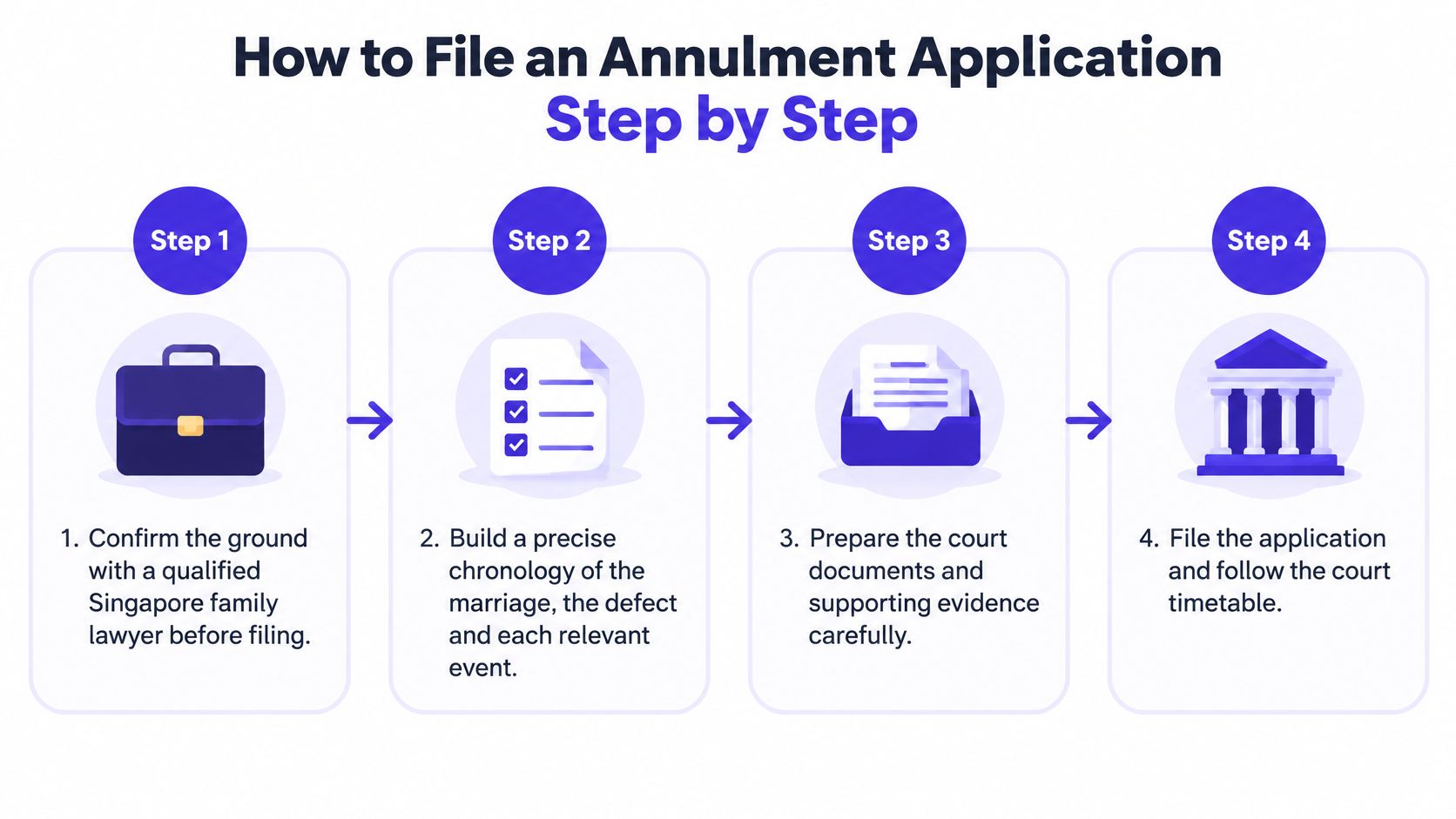
Confirm the ground with a qualified Singapore family lawyer. Explain what happened before asking which application to use. The common mistake is choosing annulment first and then trying to reshape the facts to fit it.
Build a precise chronology. Record the wedding, the alleged defect, when you discovered it and what happened afterwards. Distinguish what you personally know from what someone else told you, because the source of each fact matters.
Gather proof for each element. Relevant material may include documents, messages, medical records and witness details. Keep original files and complete conversation threads intact so the context and authenticity of the evidence can be checked.
File an Originating Application for nullity with the Family Justice Courts. This is the current commencement process rather than the former writ-based route. Use documents that match the current procedure; an old template found online may reflect rules that no longer apply.
Serve the application on the other spouse. Filing and service are separate procedural tasks: filing starts the case, while service formally notifies the respondent. Keep evidence of service and obtain advice if the spouse can't be located or ordinary service isn't practicable.
Check the response deadlines immediately. The respondent has 14 days after service to file a Notice to Contest and 28 days to file a Reply if contesting, under the procedural position described alongside the Women's Charter nullity framework. Confirm the applicable rules and court directions rather than assuming negotiations suspend a deadline.
Prepare for evidence and a possible trial. A contested matter may require affidavits of evidence-in-chief and a trial request after evidence is exchanged. Address disputed elements directly instead of repeating a broad account of an unhappy relationship.
Prove the ground to the court. Where the case is proved, the court must grant judgment of nullity. An unanswered application or agreement between the spouses doesn't replace proof of the statutory ground.
Prepare evidence around the legal test
The legal test works like a checklist: every element needs its own proof. The most common pleading mistake is describing a grievance instead of establishing a ground. A statement that your spouse misled you needs particulars: what was said, when it was said, what you understood and why it satisfies the relevant legal requirement.
Keep sensitive evidence secure. Don't access another person's accounts without authority, alter messages or coach witnesses to give matching accounts. Ask your lawyer how relevant records can be obtained lawfully.
Before the consultation: Bring the chronology, marriage certificate and supporting documents, including material that may weaken your position.
Uncontested matters usually progress more readily than contested ones because fewer factual disputes require resolution. That doesn't justify a promised completion date: service difficulties, evidence, procedural applications and related disputes can all affect progress.
Ask separately about the judgment and when it becomes final.
A hearing date or an initial order shouldn't be treated as permission to make irreversible changes to your personal or financial arrangements.
Legal Effects on Status, Children and Finances
A void marriage is treated as invalid from the outset, while a voidable marriage remains effective until the judgment becomes final. For a voidable marriage, the decision therefore operates forward from that point rather than automatically erasing everything that happened before it.
The Women's Charter also protects a child who would have been legitimate if the marriage had been dissolved rather than annulled: that child is deemed legitimate despite the annulment. Legal status and the practical arrangements for a family must therefore be considered separately.
Legal effects of void and voidable annulments
| Area | Void marriage | Voidable marriage after final judgment |
|---|---|---|
| Legal status | Treated as never validly married | Treated as having existed up to the date judgment becomes final |
| Children | Legitimacy protected where the child would be legitimate on divorce | Same protection applies |
| Transactions made during marriage | Analysed according to the facts and the ground | Transactions in the valid period analysed separately from later ones |
The table doesn't mean a void marriage leaves no financial questions to resolve. Nor does it mean every transaction during a voidable marriage will remain untouched. Ownership, agreements, statutory powers and the purpose of a transaction may all require examination.
Children's daily needs continue regardless of the application's label. Parents should address care arrangements, schooling, medical decisions, contact and financial support without treating the nullity dispute as an answer to those questions.
A timing example
Say a couple marries and a possible voidable ground surfaces eight months later. They then seek legal advice, and the court eventually grants a judgment that becomes final.
The marriage remains effective during the intervening period. If one spouse transferred money or an interest in property during that period, a lawyer would examine it in the context of a marriage that was then legally effective.
A transfer after the judgment becomes final has a different status context. That distinction doesn't establish who owns the asset or whether recovery is possible; the transaction's terms and the surrounding facts still matter.
Don't assume an annulment automatically reverses a property transfer, cancels a nomination or restores a housing entitlement.
Review financial arrangements individually
Ancillary issues such as maintenance and property require case-specific assessment. A lawyer should identify what relief is available, what evidence supports it and whether an order or separate administrative action is needed.
Before filing, prepare an organised record of the arrangements that could be affected:
- Property and housing: Ownership documents, loan statements, contributions and any proposed sale or transfer.
- Pensions and savings: Relevant account records and nominations that may require review.
- Insurance: Policy ownership, beneficiaries, premium payments and nomination documents.
- Financial commitments: Joint debts, guarantees, recurring payments and transfers between spouses.
Benefits received while the marriage was treated as valid may also need examination. Give your lawyer the relevant scheme documents rather than assuming every organisation will apply the same rule.
Avoid disposing of assets or changing important arrangements to anticipate the result. Obtain advice on preservation, disclosure and any necessary interim steps first.
Marriages of Convenience and the Immigration Ground
The immigration ground has an important exception: it doesn't apply where both parties reasonably believed the relationship would be genuine. For marriages solemnised on or after 1 October 2016, the ground concerns knowingly entering a marriage for an immigration advantage with gratification offered, given or received as an inducement or reward, as discussed in a Singapore High Court decision.
The evidence may require careful review rather than assumptions about the couple's motives.

Separate the legal questions
The test isn't whether the relationship appeared genuine. Relevant evidence may include payment arrangements, what each party knew, the wedding's timing relative to an immigration application and consistency between accounts.
The Department of Statistics' explanatory publication describes annulment as invalidation under the Women's Charter. That civil status question is distinct from immigration enforcement or criminal liability; one outcome doesn't automatically determine the other.
For a spouse who believes they were misled:
- Act early: Delay may complicate evidence and available options.
- Keep records: Preserve relationship communications, financial documents and immigration correspondence.
- Obtain advice before statements: Seek guidance before making substantive written or spoken statements to authorities, while complying with lawful requirements.
- Check parallel proceedings: Tell your lawyer about any criminal investigation or immigration action.
A qualified family lawyer can assess the nullity issue and identify whether separate immigration or criminal-law advice is needed. Avoid confronting the other spouse with allegations before considering your safety and the evidential consequences.
Annulment Numbers in Singapore and What the Data Shows
Annulments recorded and combined marital dissolutions
| Year | Annulments recorded | Combined divorces and annulments |
|---|---|---|
| 2023 | 269 | Not stated in the cited summary |
| 2024 | 304 | 7,382 |
| 2025 | 296 | 7,242 |
The annual dataset published by Singapore's Department of Statistics through data.gov.sg records 269 annulments in 2023, 304 in 2024 and 296 in 2025.
The separate annulment series distinguishes annulments from the broader marital-dissolution total.

Read the headline total carefully
SingStat's headline marital-dissolution series combines divorces and annulments. The total fell from 7,382 in 2024 to 7,242 in 2025, a decrease of 140 cases or 1.9%. It was also below the 2016–2019 average of 7,540 by 298 cases, or approximately 3.9%.
Using the figures in the table, annulments made up roughly 4% of combined dissolutions in each of the later years. This proportion describes annulments' share of the combined total; it cannot show how likely an annulment application is to succeed.
A change in the combined total alone cannot establish whether annulments rose or fell. The separate series shows recorded annulments, but does not explain the reasons for year-to-year changes.
What the counts cannot establish
The annual counts do not identify the grounds relied on, explain individual case outcomes or show whether proceedings were contested. Nor do they include the number of unsuccessful applications needed to calculate an approval rate.
Use these figures to understand the scale of recorded annulments, not to predict an individual result. Whether a marriage qualifies for annulment depends on the statutory ground and the facts and evidence of the case.
Source for the annulment series and combined totals: Singapore Department of Statistics data on marital dissolutions.
Confirm Your Ground and Speak to a Family Lawyer
A family lawyer turns the earlier sections into a decision: whether a recognised ground fits your facts, what that ground requires you to prove, and what an annulment would change for your status, children and finances.
Prepare for a focused consultation
Ask whether a time limit or bar applies. Some grounds weaken or close with delay, so raise how long you have known about the alleged defect and whether waiting affects the application.
Ask what must be proved. Which ground applies, what evidence the Women's Charter requires for it, and whether the other party could contest the application.
Ask about interim arrangements. While an application is pending, questions arise about who stays in the home, who cares for the children and how day-to-day expenses are covered. Interim orders can address these, so raise them early rather than after filing.
Take each consequence separately. Children, property, financial support and immigration follow different rules. A ground that works for changing your marital status may still leave each of these to be settled on its own.
Tell the lawyer the difficult facts. Advice based only on supportive material describes a different case from yours, and a ground can fail on facts you chose not to mention.
Verify practising status. Check the official records of the relevant Singapore authorities before appointing a lawyer. A directory profile does not replace that check.
A legal directory can help you search by expertise and location, but The Lawyer Guide's database is not an official register and may not always be complete or fully up to date. The official records of the relevant Singapore authorities are authoritative for practising or registration status.
Treat urgent proceedings differently
Where immigration enforcement, removal or a criminal investigation is involved, seek same-day legal advice rather than waiting for a routine consultation. Tell the lawyer about every notice, interview request and approaching deadline, because a missed date can limit the options available.
The Lawyer Guide helps you discover, compare and contact lawyers and law practices using information about their practice, experience and client feedback. Visit The Lawyer Guide to find family lawyers in Singapore and discuss whether annulment is the appropriate route for your circumstances.